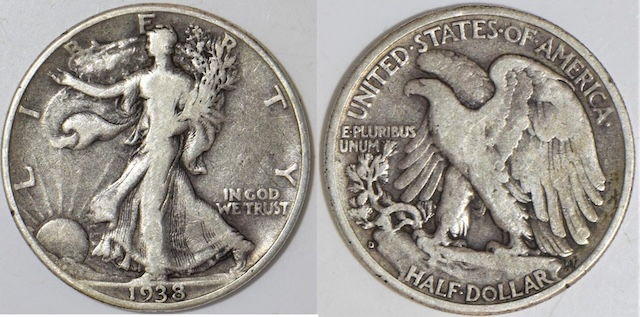
A 1938-D Walking Liberty half dollar — the third-lowest mintage in the entire series — hammered for $44,400 at Heritage Auctions in 2020. The rarest proof specimen sold for $81,562. Your coin starts at its silver melt value of about $27 and climbs from there based on mint mark, grade, and variety.
Rated 4.8 by 1,743 collectors
Check My 1938 Half Dollar Value →Do you have the scarce Denver issue worth many times more, or the more common Philadelphia coin? Walk through this quick visual check before using the calculator.
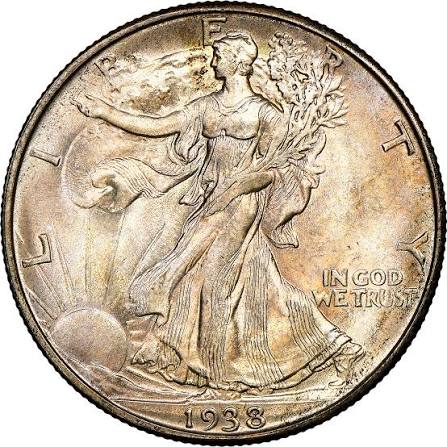
No mint mark on reverse. Over 4.1 million struck. Worth $19–$35 circulated, $95–$500+ uncirculated. The affordable entry point to the series.
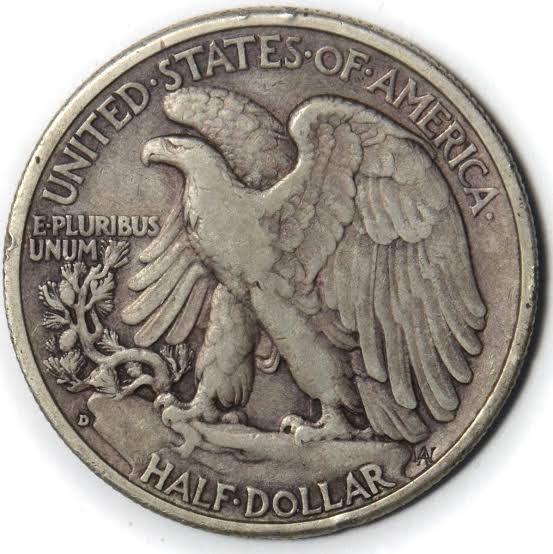
Small 'D' below eagle's tail on reverse. Only 491,600 minted — 3rd rarest business strike in the entire series. Worth $55–$650+ circulated, $650–$44,400+ uncirculated.
Check all 4 that match your coin:
Not sure of your exact grade or mint mark? Describe what you see in plain language and get a tailored assessment.
Skipped the calculator? Get a value estimate in 30 seconds — pick your mint, grade, and error.
Use the Calculator →Answer three quick questions to get an instant value estimate for your Walking Liberty half dollar.
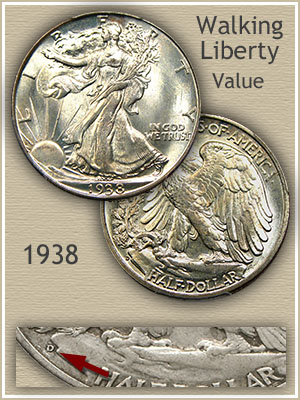
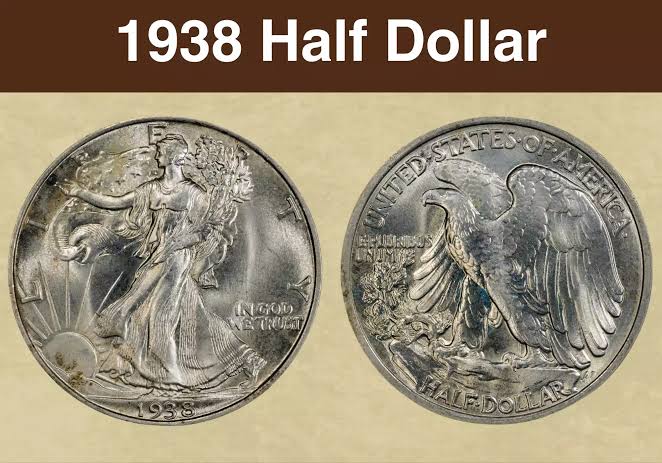
Check the reverse lower-left near the rim — a 'D' means Denver; no letter means Philadelphia. Proof coins have mirror-like fields.
Worn = flat design, readable date. Circulated = most details visible, slight friction. Uncirculated = full luster, no wear. Gem = sharp strike, strong luster, minimal marks.
New to coin collecting? If you're unsure which mint mark, condition, or error applies to your coin, there's a 1938 Half Dollar Coin Value Checker with photo upload that lets you identify your coin's details from a photo before estimating its value.
Jump to any section:
While the 1938 Walking Liberty half dollar is best known for its key-date Denver issue, several documented error types and varieties can dramatically add to a coin's value. The cards below rank each variety from most-searched to most-condition-rare, with specific identification details for each.
The 1938-D is the defining challenge coin of the Walking Liberty half dollar series' popular "short set" (1934–1947). With only 491,600 pieces struck at the Denver Mint, it ranks as the third-lowest mintage of the entire 65-coin Walking Liberty series, surpassed in scarcity only by the legendary 1921 and 1921-D issues from the coin's troubled early years.
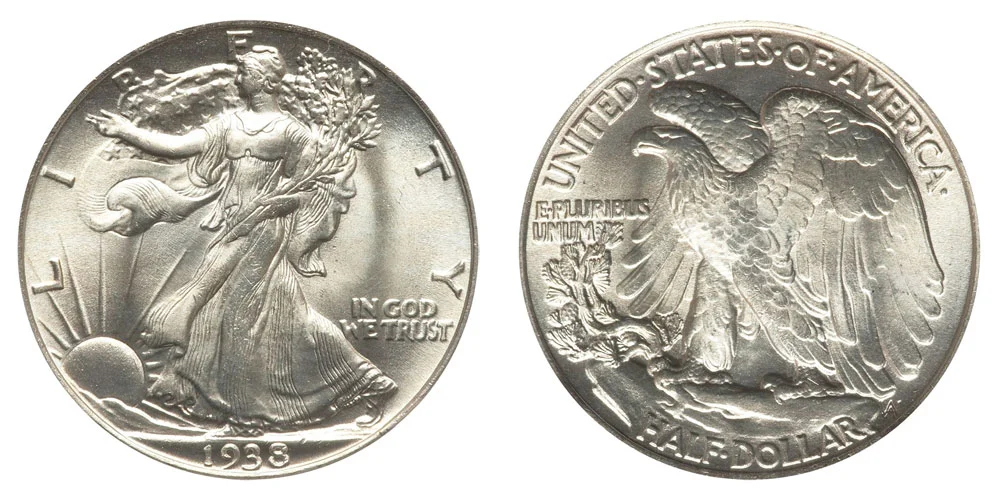
Paradoxically, while this coin is genuinely scarce in circulated grades — where few were set aside — it is relatively more available in uncirculated condition. Coin dealers began saving rolls of new issues starting around 1934, so BU rolls of the 1938-D were preserved. The strike quality is typically excellent, with well-defined eagle feathers and Liberty's gown lines sharp by the standards of the series.
In gem uncirculated grades (MS65 and above), condition rarity drives dramatic value escalation. PCGS has certified only 132 examples in MS67, with just 13 reaching MS67+. CAC, the independent authentication body, has stickered only 202 examples in MS66 with fewer than 25 approved above that grade. The certified record — an MS67+ — realized $44,400 at Heritage Auctions in September 2020, confirming the coin's status among the most desirable 20th-century half dollars.
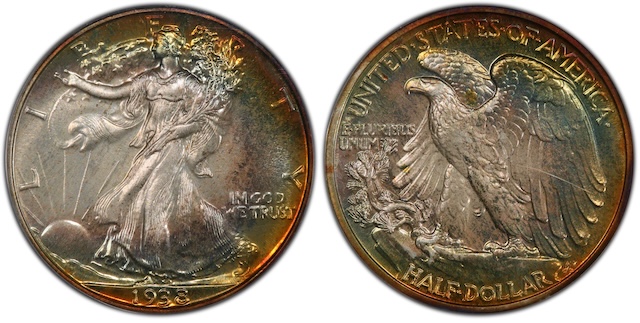
With only 8,152 proof coins struck in 1938, this issue stands as the third-rarest proof date in the entire Walking Liberty half dollar series. The Philadelphia Mint produced these special collector strikes using polished dies and planchets, resulting in deeply mirrored fields that sharply contrast with the raised design elements of Liberty and the eagle.
The 1938 proof is notable for its technical quality. The Greysheet describes it as "known for deep mirrored gems that are not too hard to find" at mid-grade levels — a tribute to the mint's craftsmanship that year. However, the upper echelons of the grade scale are another matter entirely. PCGS has certified only 28 examples in PR68 and just 2 in PR68+, making the finest-known specimens extraordinarily condition-rare among the assembled proof Walker specialist community.
The absolute auction record for any 1938 half dollar belongs to this proof issue: a PR68+ CAC coin — the single finest known — sold for $81,562 at GreatCollections in April 2020, attracting bids from 11 different collectors. Cameo (CAM) and Deep Cameo (DCAM) designated proofs carry significant additional premiums, as they display stark contrast between the frosted devices and mirror-like fields — an aesthetic that defines the most desirable proof coins in any series.
The 1938-D/D Repunched Mint Mark is one of the most visually clear RPM varieties in the entire Walking Liberty half dollar series. This error occurred when a mint worker applied the 'D' punch to the working die twice, with the second impression landing at a slightly different position than the first — leaving a ghostly secondary 'D' visible adjacent to or overlapping the primary mark. The variety is listed in major catalogues and actively sought by both Walking Liberty specialists and error coin collectors.
Identifying the RPM requires a 5× to 10× loupe and careful examination of the mint mark area on the reverse. The secondary 'D' typically appears to the north, south, or at a slight rotation relative to the primary. The doubling can manifest as a distinct secondary serif, a shadow-like companion mark, or a thickened portion of one side of the primary letter. The strength of the repunching varies across different die pairs, so some examples are dramatically clear while others require more careful inspection.
Because the 1938-D itself is a scarce key date, finding an RPM specimen adds a meaningful premium on top of an already-elevated base value. Collectors appreciate this variety both for its visual drama and for the historical narrative it provides — evidence of the manual, skilled work involved in preparing dies at the Denver Mint in 1938. Premium examples in uncirculated condition command strong interest from specialists who pursue CONECA-listed varieties across the Walking Liberty series.
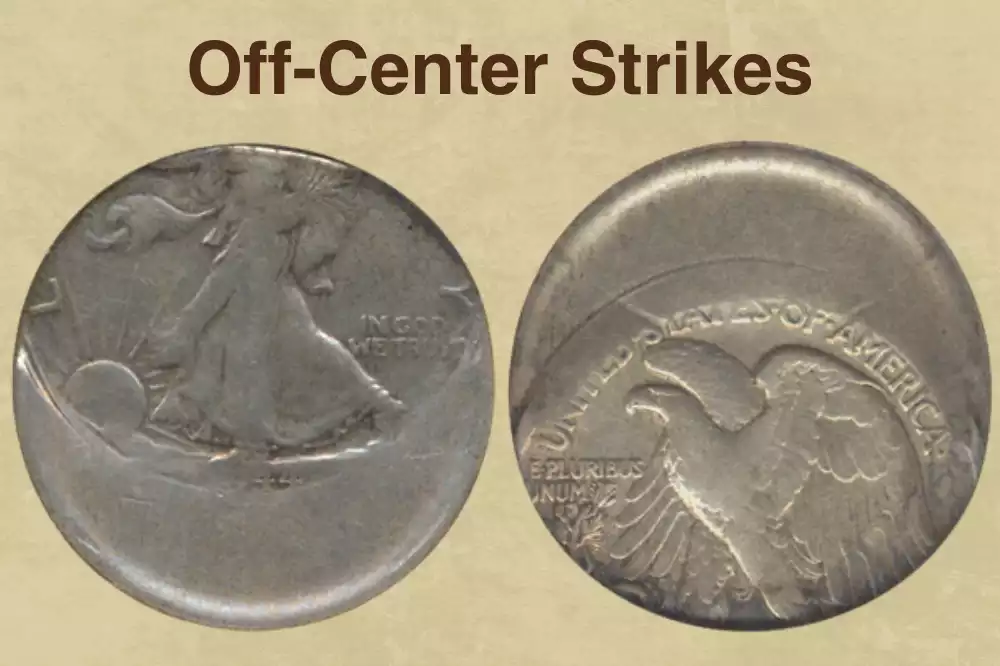
An off-center strike occurs when the planchet (coin blank) is not properly centered between the dies at the moment of striking. The result is a coin where the entire design appears shifted to one side, with a crescent of plain, unstruck planchet metal visible on the opposite side. On the large-diameter, high-relief Walking Liberty half dollar, off-center strikes create a visually dramatic effect as Liberty and the eagle appear to be sliding off the edge of the coin.
The value of an off-center strike scales directly with the degree of misalignment. A mild 5–10% shift adds modest value, while 20–50% off-center examples where the design has clearly migrated but the full date '1938' remains readable are the most desirable. Collectors insist on date visibility — without '1938' showing, attribution is impossible and value drops considerably. Dramatic shifts of 50%+ that still retain the date are extreme rarities in any denomination and command the highest premiums.
Because the Walking Liberty half dollar was a 30mm, 12.5-gram coin struck in 90% silver, off-center examples are larger and more impressive than off-center strikes on smaller denominations. This physical presence drives collector demand well above what a comparable off-center Lincoln cent would fetch. Authentication by PCGS or NGC is strongly recommended before purchase or sale, as post-mint damage can sometimes mimic the appearance of a genuine striking error.
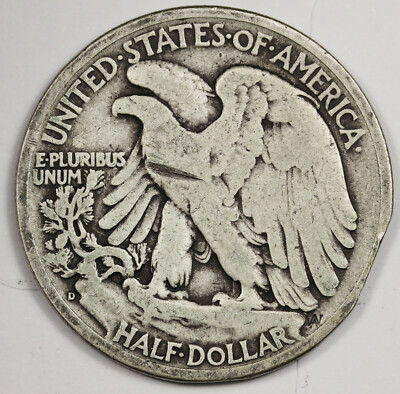
Clipped planchet errors occur during the blank (planchet) preparation stage of coin production, before a blank ever reaches the striking dies. When the punch that cuts circular blanks from a long strip of silver alloy overlaps a previously punched hole, the resulting blank has a curved or straight section missing from its circumference — as if a bite were taken out of the rim. The coin is then struck normally, but the missing section persists through the final coin.
Curved clips (by far the most common type) present as a concave bite in the rim, following the arc of a previously punched hole. Straight clips result from the punch overlapping the end of the strip and create a flat, straight-edged cut. On a Walking Liberty half dollar — a large-diameter 30mm coin — even a minor clip is immediately visible and adds measurable collector interest. The Blakesly effect is a diagnostic test for curved clips: the area of the design directly opposite the clip is typically weak or missing because metal didn't flow into that portion of the die.
The value premium for clipped planchet errors on 1938 halves depends primarily on the size of the clip and the preservation of the date and major design elements. Minor clips removing a small sliver of rim (under 5% of the coin's circumference) add $50–$150, while dramatic clips removing 15–25% of the edge can bring $300–$800 or more. As with all error coins, professional third-party authentication by PCGS or NGC is strongly recommended to confirm the clip is a genuine mint error and not a post-mint alteration.
Found one of these errors on your coin? Get an instant value estimate — pick your mint, grade, and error type.
Calculate My Coin's Value →The table below summarizes current retail value ranges for each 1938 Walking Liberty half dollar variety across the four major condition tiers. For a complete step-by-step 1938 half dollar identification walkthrough and detailed photo grading reference, see the in-depth 1938 Walking Liberty breakdown and guide. Values shown are retail estimates; actual realized prices vary by specific grade, eye appeal, and market conditions. Silver melt value (~$27) provides a floor for all circulated examples.
| Variety | Worn (G–VF) | Circulated (EF–AU) | Uncirculated (MS60–64) | Gem (MS65+) |
|---|---|---|---|---|
| 1938-P (Philadelphia) | $19 – $35 | $38 – $95 | $95 – $250 | $325 – $18,400 |
| ⭐ 1938-D (Denver — Key Date) | $55 – $155 | $200 – $590 | $650 – $2,000 | $1,850 – $44,400+ |
| 🔴 1938 Proof (PR60–PR67) | — | $400 – $750 | $960 – $2,070 | $2,500 – $81,562+ |
| 1938 Proof CAM / DCAM | — | — | $1,430 – $5,980 | $18,400 – $81,562+ |
| 1938-D/D RPM (add to D value) | +$15 – $40 | +$40 – $100 | +$100 – $300 | +$300 – $500+ |
⭐ Gold row = key date 1938-D. 🔴 Red row = rarest (proof). Values are retail estimates based on PCGS price guide, NGC price guide, and Heritage Auctions realized prices. Individual coins may sell higher or lower.
📱 CoinHix is a fast on-the-go coin identifier — snap a photo of your 1938 half dollar to quickly cross-reference your estimated value against live market data — a coin identifier and value app.
| Mint / Issue | Mintage | Est. Survivors Today | Notes |
|---|---|---|---|
| Philadelphia (No Mint Mark) | 4,110,000 | Several hundred thousand | Lowest P-Mint mintage of the 1934–1946 span; uncirculated rolls were saved but modestly |
| Denver (D) — Key Date | 491,600 | ~30,000 (est. by PCGS) | 3rd lowest mintage in series; relatively well-struck; PCGS: 132 in MS67, 13 in MS67+ |
| Proof (Philadelphia) | 8,152 | Several thousand | 3rd rarest proof in series; PCGS: 28 in PR68, 2 in PR68+; CAM examples exist |
| San Francisco | 0 | — | No 1938-S half dollar was produced |
| Total 1938 | 4,609,752 | — | All business strikes + proofs |
Condition determines the majority of your coin's value. Use these four benchmark tiers to place your 1938 half dollar on the Sheldon 70-point scale before checking the value chart above.
Liberty is mostly an outline with a readable date. No breast detail visible in Good; fine gown lines appear by VF but Liberty's left arm and right breast show flattening. The motto "IN GOD WE TRUST" is distinct but relief is low. Eagle feathers are mostly flat in Good, gaining definition by Fine. 1938-P: $19–$35 · 1938-D: $55–$155
Most of Liberty's gown lines are visible in EF; nearly all are present in AU. High points — Liberty's left arm, right breast, eagle's chest — show friction or slight flatness. Mint luster may survive in protected areas at AU-55/58. On the 1938-D, this grade range is genuinely scarce because few circulated coins were saved in the 1930s. 1938-P: $38–$95 · 1938-D: $200–$590
No wear whatsoever — confirm by slowly rotating under a single light source to check that luster bands run unbroken rim-to-rim. Contact marks in prime focal areas (Liberty's cheek, eagle's breast) determine the MS60–64 spread. The 1938-D often shows cartwheel luster in uncirculated grades; the 1938-P at MS63 still has noticeable marks in the fields. 1938-P: $95–$250 · 1938-D: $650–$2,000
Strong, original cartwheel luster with only minimal, scattered contact marks visible under magnification. At MS-65, eye appeal must be above average. MS-67 examples of the 1938-D are extreme rarities — only 132 exist at PCGS, and the record MS-67+ sold for $44,400. A "+" designation can add 50–100% to the base price at any gem grade level. CAC approval adds additional value and marketability. 1938-P: $325+ · 1938-D: $1,850+
🔬 CoinHix lets you match your coin's condition against certified grading examples from your phone — snap a photo and compare it side-by-side with graded specimens — a coin identifier and value app.
Different venues suit different coin grades. Here's how to match your coin to the right market.
The world's largest numismatic auctioneer, Heritage is the ideal venue for gem 1938-D examples (MS65 and above) and proof coins. The 1938-D MS67+ record sale of $44,400 and the PR68+ record of $81,562 were both realized through major auction houses. Consignment fees apply, but competitive bidding from serious collectors typically maximizes realized price for top-quality specimens. Best for: MS65+ 1938-D and all proof grades.
The largest retail marketplace for 1938 half dollars across all grades. To see what recently sold prices for 1938 Walking Liberty halves on the open market look like, completed listing data gives you a real-time price benchmark. Best for mid-grade coins (VF–MS63) where the audience is broad. Certified (PCGS/NGC slabbed) coins sell faster and for more. Avoid selling raw gem examples without certification — buyers will discount for unverified grade.
For quick, no-hassle liquidation of circulated 1938-P coins or low-grade 1938-D pieces, your local dealer offers immediate payment. Expect to receive wholesale (60–75% of retail) rather than full market value. Dealers must leave room for their own markup and carrying costs. Worth calling ahead to confirm they buy Walking Liberty halves — some shops specialize in modern coins only. Bring a price guide printout to inform your negotiation.
A growing community of enthusiast buyers who pay closer to retail than dealers, while skipping auction fees. The subreddit r/Coins4Sale and r/CoinSales are active for mid-grade Walking Liberty halves. Requires good photography, honest description, and a history of positive trades. Not ideal for high-value 1938-D gems — auction houses generate far more competitive bidding for those. Best for: circulated to MS63 range coins where you want more than dealer wholesale without paying auction fees.
A 1938 Philadelphia half dollar is worth approximately $19–$35 in circulated condition and $95–$500+ in uncirculated grades, depending on quality. The scarce 1938-D (Denver) starts around $55 worn and jumps to $650+ in uncirculated condition. Proof issues from 1938, with only 8,152 struck, are valued from around $400 to over $25,000 for top-grade specimens. Silver melt value currently provides a $25–$27 floor for all examples.
The 1938-D Walking Liberty half dollar is a key date because only 491,600 were struck at the Denver Mint — the third-lowest mintage in the entire Walking Liberty series (1916–1947), behind only the 1921 and 1921-D issues. PCGS estimates fewer than 10% of the original mintage survives today. In gem uncirculated grades, fewer than 200 CAC-approved examples exist above MS65, making top specimens extremely condition-rare and highly sought by advanced collectors.
The all-time auction record for any 1938 half dollar is $81,562, realized at GreatCollections in April 2020 for a Proof-68+ CAC example — the finest known from the original 8,152 proof mintage. For business strikes, the record belongs to a 1938-D graded MS67+ that sold for $44,400 at Heritage Auctions in September 2020. The Philadelphia business strike record stands at $18,400 for an MS68 example sold at Heritage Auctions in 2011.
The mint mark on a 1938 Walking Liberty half dollar is located on the reverse (back) of the coin, on the lower left side near the rim, just below the eagle's tail feathers. A 'D' indicates the Denver Mint, while no mint mark means the coin was struck at the Philadelphia Mint. Philadelphia was the only mint to produce proof versions in 1938, and those proof coins carry no mint mark either.
Flip the coin to the reverse (eagle side) and look at the lower-left area near the rim, below the eagle's tail. If you see a small 'D' letter in that location, you have the scarce Denver issue. If the area is blank, you have the more common Philadelphia coin. Confirm the date reads '1938' on the obverse. Also check for the 1938-D/D repunched mint mark variety — look for a secondary 'D' impression slightly offset from the primary using a 5–10× loupe.
Yes. The most documented variety is the 1938-D/D Repunched Mint Mark (RPM), where the 'D' was stamped twice at a slightly different position. Off-center strikes on 1938 half dollars can fetch $500–$2,000 depending on the degree of misalignment. Clipped planchet errors add $50–$800 in value. Lamination errors (silver-copper alloy separations) are occasionally found and add $50–$300. Broadstruck examples without a collar typically bring $200–$600.
The key grading points on a Walker are Liberty's left hand and head, her gown lines, and the eagle's breast and left leg on the reverse. In Good grade, Liberty is mostly an outline with a readable date. Very Fine coins show most gown lines. Extremely Fine pieces have nearly all details visible. Uncirculated coins retain full original luster across all surfaces. For the 1938-D, also note that many examples are well-struck — a weak-looking hand isn't automatic evidence of wear.
The 1938 Walking Liberty half dollar is composed of 90% silver and 10% copper. It weighs 12.50 grams with a diameter of 30.00 mm and has a reeded edge. The coin contains 0.36169 troy ounces of pure silver. At current spot prices (approximately $75/oz), the silver melt value is roughly $27, providing a firm price floor for even the most heavily worn examples regardless of numismatic condition.
Absolutely. With only 8,152 proof coins struck, the 1938 proof Walker is one of the rarer proof issues in the series and commands significant premiums. In PR65 condition, examples are valued around $750–$960. PR68 examples certified by PCGS (only about 28 known) have sold at Heritage for around $6,000. The finest known — a PR68+ CAC — realized $81,562 at GreatCollections in 2020. Cameo proofs are especially rare and carry premium values.
No — never clean a 1938 half dollar or any collectible coin. Cleaning destroys the original mint luster and leaves hairline scratches invisible to the naked eye but easily detectable under magnification and by professional graders. A cleaned coin can lose 50–80% of its value compared to an equivalent problem-free example. Even a lightly polished 1938-D can drop from a $650 MS60 to being worth only its $27 silver melt value. Always sell coins in the condition in which you found them.
Use the free calculator — select your mint, condition, and any errors — and get an instant estimate for your 1938 Walking Liberty Half Dollar.
Calculate My 1938 Half Dollar Value →